The Quiet Reorganization Happening in Your Neighborhood
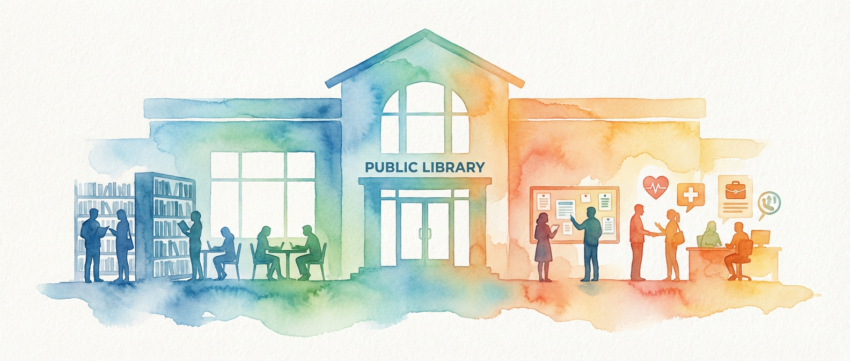
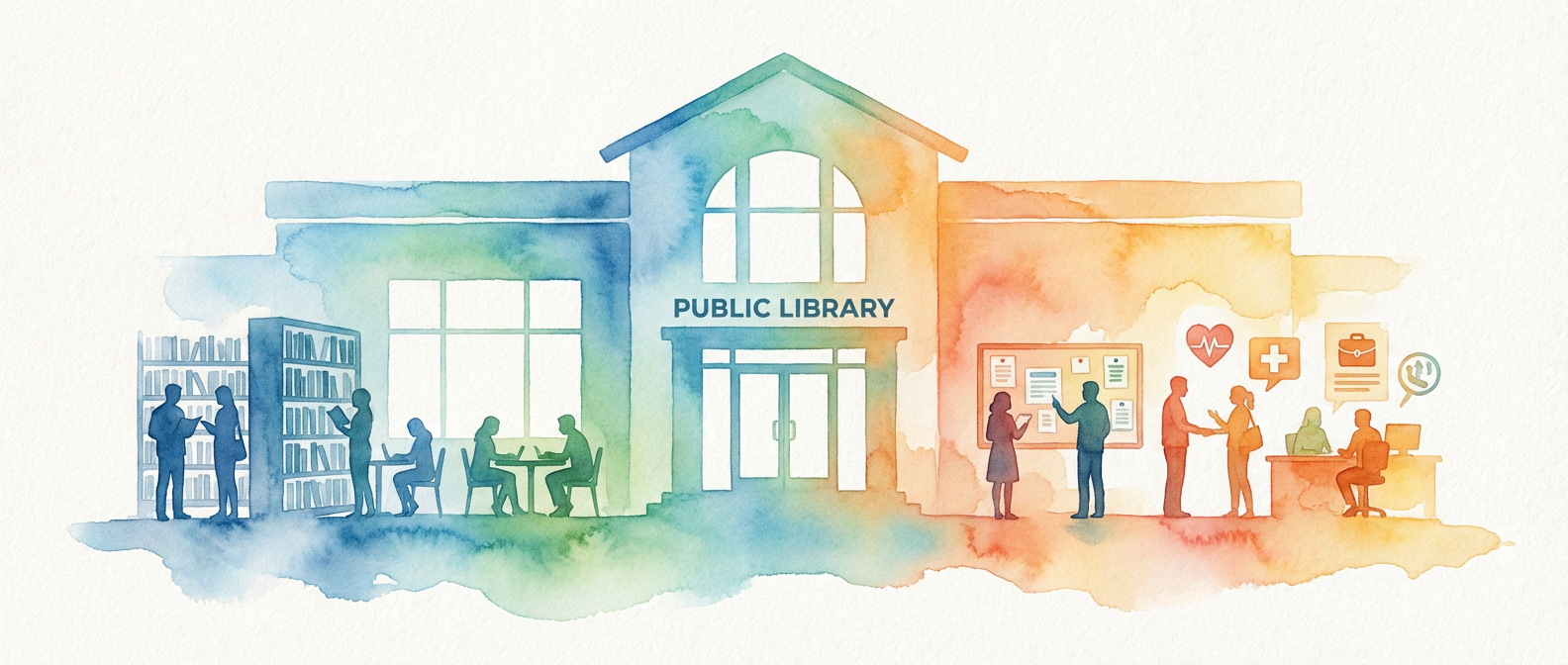
If you haven’t been to your public library in a while, you might walk in expecting the same setup you remember from ten years ago: rows of books, a computer lab, maybe a community bulletin board. What you’ll actually find looks less like a traditional library and more like a social infrastructure building designed to catch people who are falling through every other system crack.
This isn’t happening because libraries suddenly decided to rebrand themselves. It’s happening because the gaps in our social safety net have become so visible, so urgent, and so concentrated in the same physical spaces where libraries already exist, that librarians made a choice: adapt or watch your community collapse around you. The shift accelerated quietly through 2024 and 2025, and now it’s just the reality of what a library does.
The numbers tell the story. According to the American Library Association State of America’s Libraries 2025, nearly three quarters of public libraries now offer at least one social service that goes far beyond lending books. Mental health referrals, benefits enrollment help, job training programs, housing navigation, substance use support — these are now standard library functions in most communities. And that trend isn’t slowing down.
What Denver Got Right (And What It Actually Cost)
Denver Public Library’s experience offers the clearest case study of what this shift actually looks like on the ground. Back in 2018, library leadership made a decision that seemed radical at the time: hire licensed social workers and embed them directly in library branches. They didn’t outsource this work to a partner organization. They didn’t create a referral hotline. They put actual licensed professionals in the building, trained, equipped, and authorized to do the work.
By 2024, that program had handled over 14,000 patron interactions. That’s not 14,000 people receiving a pamphlet. That’s 14,000 individual moments where someone walked into a library branch and got connected to a social worker who could help navigate concrete problems: accessing mental health care, applying for unemployment benefits, getting connected to housing assistance, dealing with substance use issues. Many of these interactions required multiple follow-ups, advocacy, and coordination with external agencies.
Here’s what matters if you’re trying to replicate this in your own community: it required sustained funding. It required training. It required library staff to undergo significant operational changes. A library director can’t just announce that social workers are now part of the team and expect it to work. You need structural change, budget reallocation, and a genuine philosophical commitment. Denver made that commitment, and the interaction numbers reflect it.
The Money Finally Followed the Need
What’s shifted in 2025 is that federal funding mechanisms now explicitly support this work. The Institute of Museum and Library Services awarded $282 million in grants this fiscal year, with a historically high 31 percent directed specifically toward libraries functioning as community resilience centers. This isn’t accidental money. These are grants with names like “Strengthening Libraries as Community Resilience Centers” and “Connecting Libraries to Social Services Infrastructure.”
If your library hasn’t tapped into these funds, that’s worth raising in a conversation with your library director or at a board meeting. The Institute of Museum and Library Services Grant Programs publishes open applications, and many communities don’t realize these funds exist or how specifically they can be deployed. Some libraries have used them to hire dedicated social workers. Others have funded training for existing staff or built partnerships with community health organizations.
The funding shift matters because it signals that this isn’t a temporary emergency response. It’s the recognized new role of public libraries in American infrastructure. Libraries can now make multi-year plans around social services work, hire permanent staff, and build programs with some confidence that next year’s budget will support what they’re creating this year.
Why People Are Actually Walking Through the Door
A Pew Research survey from 2025 found that 65 percent of Americans visited a public library at least once in the past year. That’s a reassuring number for a profession that’s been worrying about relevance for decades. But the more striking finding is the reason people are going: 28 percent cited social services or community programming as their primary reason for the visit. In 2016, that number was 11 percent. That’s not a marginal shift. That’s a fundamental redefinition of what people think libraries are for.
This matters because libraries aren’t expanding social services despite their core mission. The data suggests they’re expanding social services because their core mission is being understood and lived out differently. For people who need help, the library is now a place to get that help. That means their buildings are more crowded, more diverse in terms of patron needs, and more central to community survival than they’ve been in a long time.
San Francisco’s Harm Reduction Story
San Francisco’s library system implemented a harm reduction partnership starting in 2023. By 2025, they had distributed over 1.2 million naloxone doses through library branches. Let that number sit for a moment. One point two million doses. That’s not a peripheral program. That’s a core public health intervention delivered through library infrastructure.
This is the kind of program that some communities debate endlessly in city council meetings before implementing, if they implement it at all. San Francisco made a choice to deploy harm reduction resources through libraries because libraries are in every neighborhood, they’re trusted by people who are isolated from traditional health systems, and they’re open during hours when people are actually navigating crisis situations. It works because of clear leadership, partnership with health agencies, and staff training.
If your community is struggling with substance use, housing instability, or mental health crises, this is the kind of program worth advocating for. Libraries are uniquely positioned to deliver it. They’re already in your neighborhood, already trusted, already staffed. The question is whether your library leadership and community are ready to resource this work properly.
What to Do With This Information
The practical next step is simple: find out what your library is already doing. Call or visit and ask. What social services are currently available? What’s in development? Is there a person or department focused on community resilience? What are the gaps they’re trying to fill? Then ask yourself if what you’re hearing matches the actual needs you see in your neighborhood.
If your library isn’t far along in this shift, there’s room for advocacy. Go to a library board meeting. Talk to your city council representative. Look at grant opportunities. Connect with people at neighboring libraries who have already done this work. This isn’t theoretical. It’s happening in real time, and the difference between a library that’s actively building social services infrastructure and one that’s still thinking about it is often just a group of people who cared enough to show up and push for it. Meet me there on Saturday.