The Numbers Tell a Story
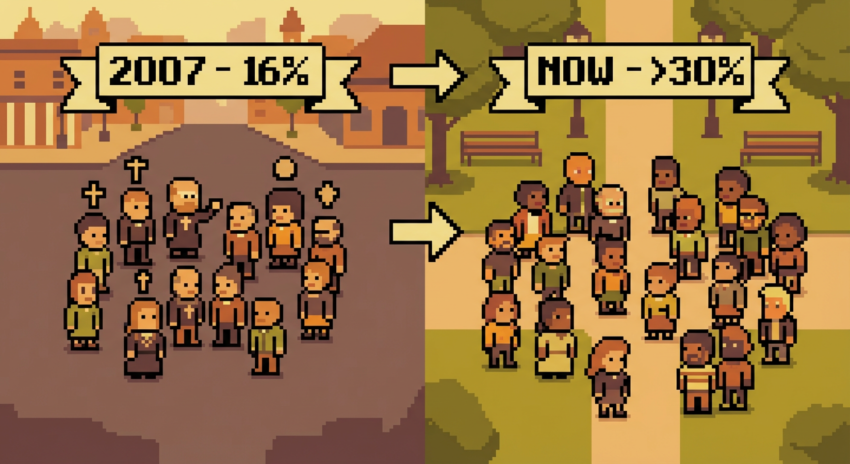
Walk through any American neighborhood today and you’ll notice something different about the religious landscape. The churches, synagogues, and mosques still stand, but the rhythms have changed. What was once predictable has become uncertain. Pew Research religion data shows a striking shift: nearly one in three American adults now identifies as religiously unaffiliated, nearly doubling from just sixteen percent in 2007.

This isn’t just about belief or doctrine. It’s about the breakdown of social structures that once held communities together. The Wednesday night potluck dinners, the volunteer networks that responded to family emergencies, the connections between grandparents and kids in Sunday school classrooms. These weren’t just religious activities. They were the backbone of American community life.
But the story isn’t simple decline. Within this broader trend, something more complicated is happening. The fastest growing religious identification isn’t atheism or agnosticism, but “spiritual but not religious.” People want connection, meaning, and transcendence. They’re just finding it outside traditional institutions.
What Cannot Be Replaced
Community centers can host meetings. Libraries can provide gathering spaces. But faith communities offer something qualitatively different: systems built around care rather than consumption, relationship rather than transaction. When Mrs. Rodriguez breaks her hip, it’s the church ladies who organize meal trains without being asked. When the Johnson family faces eviction, it’s the mosque community that quietly passes the collection plate.
This system operates on different principles than secular alternatives. It’s organized around covenant rather than contract, sustained by shared meaning rather than membership fees. The volunteer who drives elderly congregants to doctor’s appointments isn’t motivated by tax deductions or resume building. They’re acting from conviction that such care is sacred work.
Professional social services, valuable as they are, cannot replicate this density of relationship. Government programs operate within bureaucratic constraints. Nonprofit organizations depend on grant cycles and donor priorities. Faith communities, at their best, respond to need because it exists, not because it fits predetermined categories or funding requirements.
The loss isn’t just organizational. It’s cultural. Faith communities have been places where different generations interact naturally, where life transitions are marked collectively, where individual struggles become shared burdens. As these institutions weaken, we lose practiced ways of being together across difference.
Adaptation in Real Time
Some religious communities are finding new life by embracing change rather than resisting it. Progressive congregations are growing even as conservative denominations shrink, often by focusing less on doctrinal purity and more on social justice work. These communities attract people who might never darken a traditional church door but hunger for collective action rooted in deeper values.
The pandemic accelerated innovations already underway. Online worship services, initially emergency measures, have kept roughly forty percent of their digital attendance even as in-person gatherings resumed. This isn’t just convenience. Virtual participation has allowed people with mobility challenges, work constraints, or social anxiety to engage with religious community in ways previously impossible.
Small group ministries, community gardens, mutual aid networks, and advocacy coalitions have become entry points for people who appreciate faith communities’ organizing capacity without necessarily sharing their theological commitments. Religion News Service regularly reports on congregations that function more like community organizing hubs than traditional worship centers.
These adaptations suggest that what people valued about religious community wasn’t always the religion itself, but the community. The question is whether faith traditions can maintain their distinctive contributions while welcoming broader participation.
Coalition as Sacred Work
Maybe the most promising development is the rise of interfaith collaboration around concrete community needs. Housing advocacy, immigration support, and anti-poverty work increasingly bring together diverse religious traditions alongside secular partners. These coalitions leverage the organizational strength and moral authority of faith communities while avoiding the sectarian divisions that often paralyze religious cooperation.
When multiple congregations unite to pressure city council for affordable housing, they’re not acting as Methodists or Muslims or Jews. They’re acting as neighbors convinced that decent shelter is a human right. This shared moral foundation can sustain collaboration even across theological disagreement.
Such work also demonstrates faith communities’ continued relevance to secular society. The environmental justice pastor, the rabbi organizing for criminal justice reform, the imam advocating for refugee resettlement. These religious leaders aren’t retreating into private piety. They’re claiming public space for moral discourse.
These coalitions often prove more effective than purely secular organizing because they can mobilize not just individual conscience but communal commitment. People will attend a city council meeting because their congregation asked them to, even if they wouldn’t normally engage in civic activism.
What Remains Sacred
As religious affiliation declines and spiritual seeking increases, faith communities face a fundamental question: what is their irreplaceable contribution to human flourishing? The answer may lie not in preserving institutional forms but in maintaining institutional functions. The capacity to gather people around shared purpose. The practice of mutual care. The insistence that individual wellbeing cannot be separated from collective responsibility.
These functions don’t require theological agreement. They do require commitment to something beyond immediate self-interest. Faith communities, even in their weakened state, remain among our most practiced institutions for cultivating such commitment. They know how to ask people to give time, money, and attention to others’ needs. They know how to sustain volunteer energy across years rather than months.
The challenge is whether these communities can maintain their distinctive strengths while adapting to cultural change. Can they welcome the spiritually curious without abandoning the religiously committed? Can they engage public issues without becoming political organizations? Can they embrace innovation while preserving wisdom?
These questions matter beyond religious circles. In an increasingly fragmented society, we need institutions that can build bridges across difference, maintain long-term relationships, and mobilize care for those most vulnerable. Faith communities, despite their flaws and limitations, are still uniquely positioned for this work. Their future shapes all our futures.